


1. DeepSeek-V4-Flash-0731
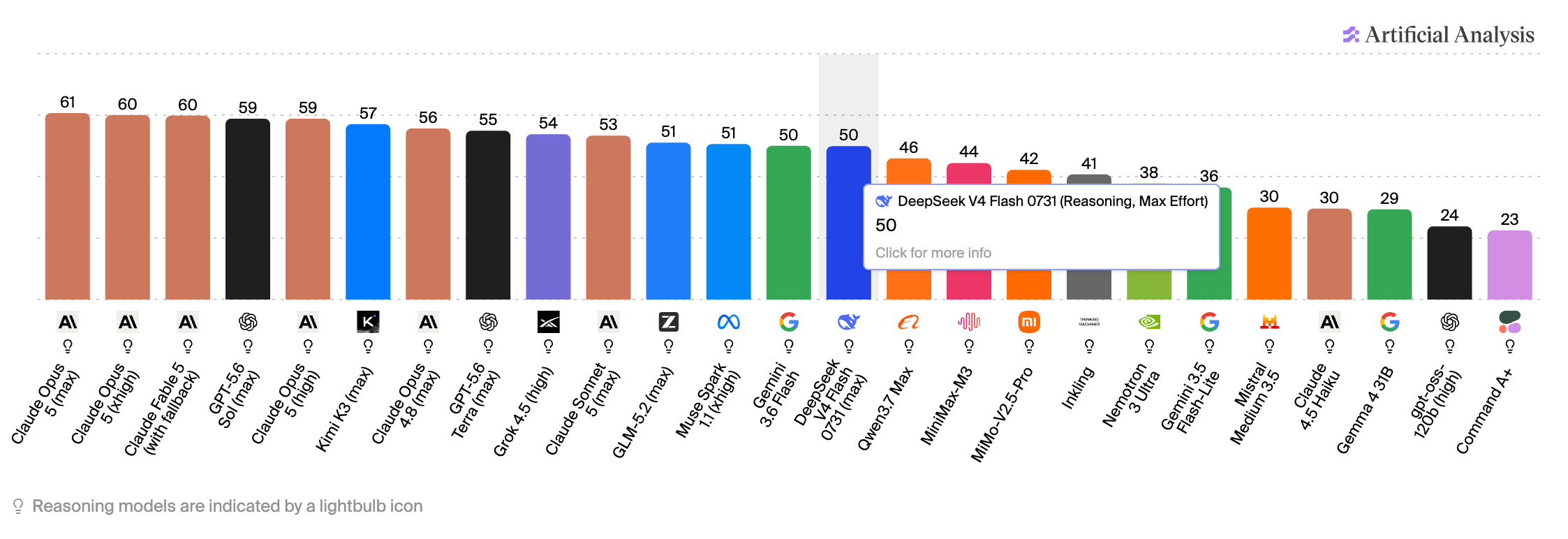
DeepSeek-V4-Flash-0731 is the official release of DeepSeek-V4-Flash that replaces its preview version.
The model has a 304B-parameter architecture, uses DSpark speculative decoding for faster inference, and supports low, high, and max reasoning-effort levels.
It outperforms the preview version on multiple benchmarks while activating fewer parameters, and has competitive performance with the strongest proprietary models available today.
It scores 50 points on the Artificial Analysis Intelligence Index, similar to GPT-5.6 Luna (51 points) and Google Gemini 3.6 Flash (50 points), while costing ~60% less per task than Luna and 10x less than Gemini, with a 98% discount on cache hits.
Read more about this release using this link.
2. Pangram 4
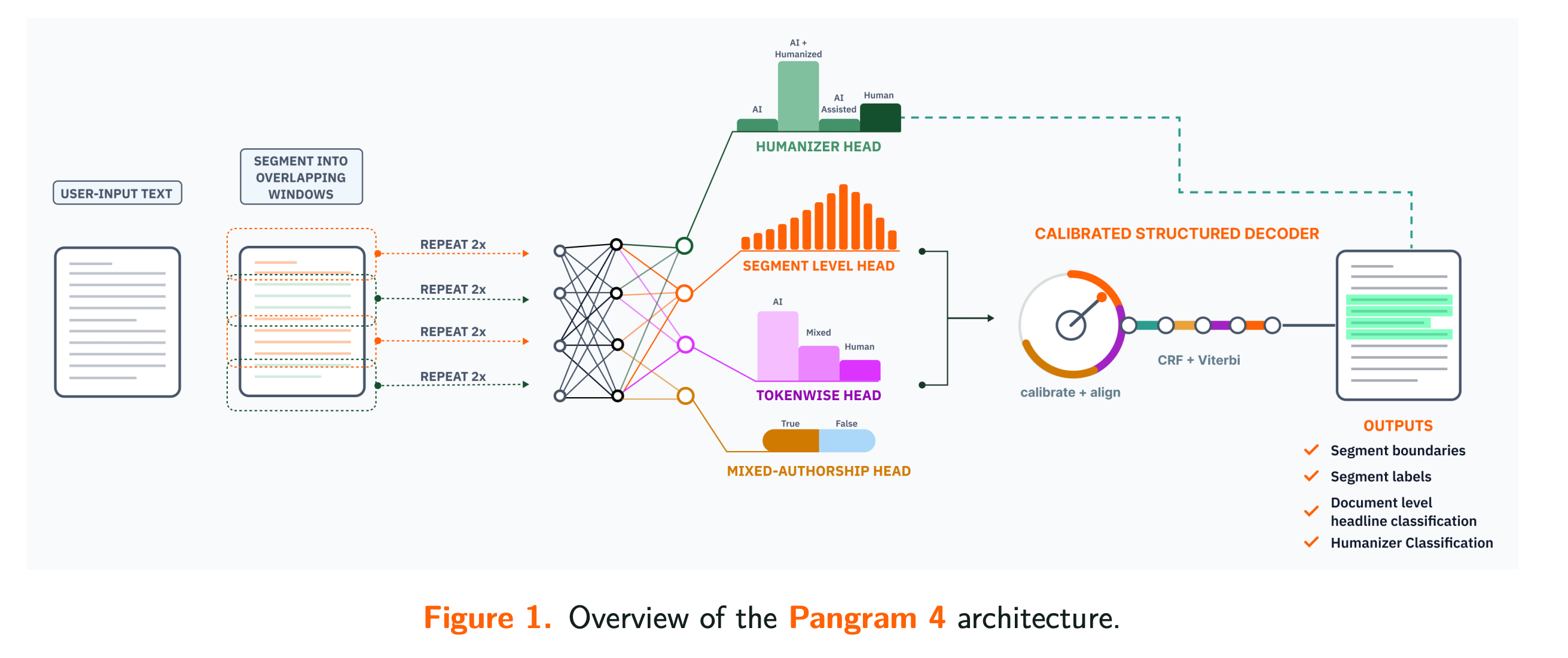
Pangram 4 is the latest deep-learning-based AI-text classification model from Pangram Labs with state-of-the-art performance in AI text detection and is being used by Substack to detect ever-increasing AI slop.
Pangram 4 is a LoRA fine-tuned MoE model trained on human text paired with AI-rewritten and AI-edited versions of itself, labeled clause-by-clause by matching against the human source. At inference, it scores overlapping 512-token windows, averages the logits, and uses a CRF (Conditional Random Field) to decode the authorship spans.
On AI-text classification, it achieves an AUROC of 0.9916, a false positive rate of 0.0041% (roughly 1 in 24,000), and a false negative rate of 0.3396%.
Read more about this research using this link.
Join the paid tier today to get access to all articles in this newsletter and level up as an AI engineer.
3. Frontis-MA1
This research introduces OpenMLE, an open full-stack system for Recursive self-improvement (RSI) research covering:
Verifiable task environments with execution feedback (OpenMLE-Gym)
Operator learning (OpenMLE-ERL)
Long-horizon search (OpenMLE-Evo)
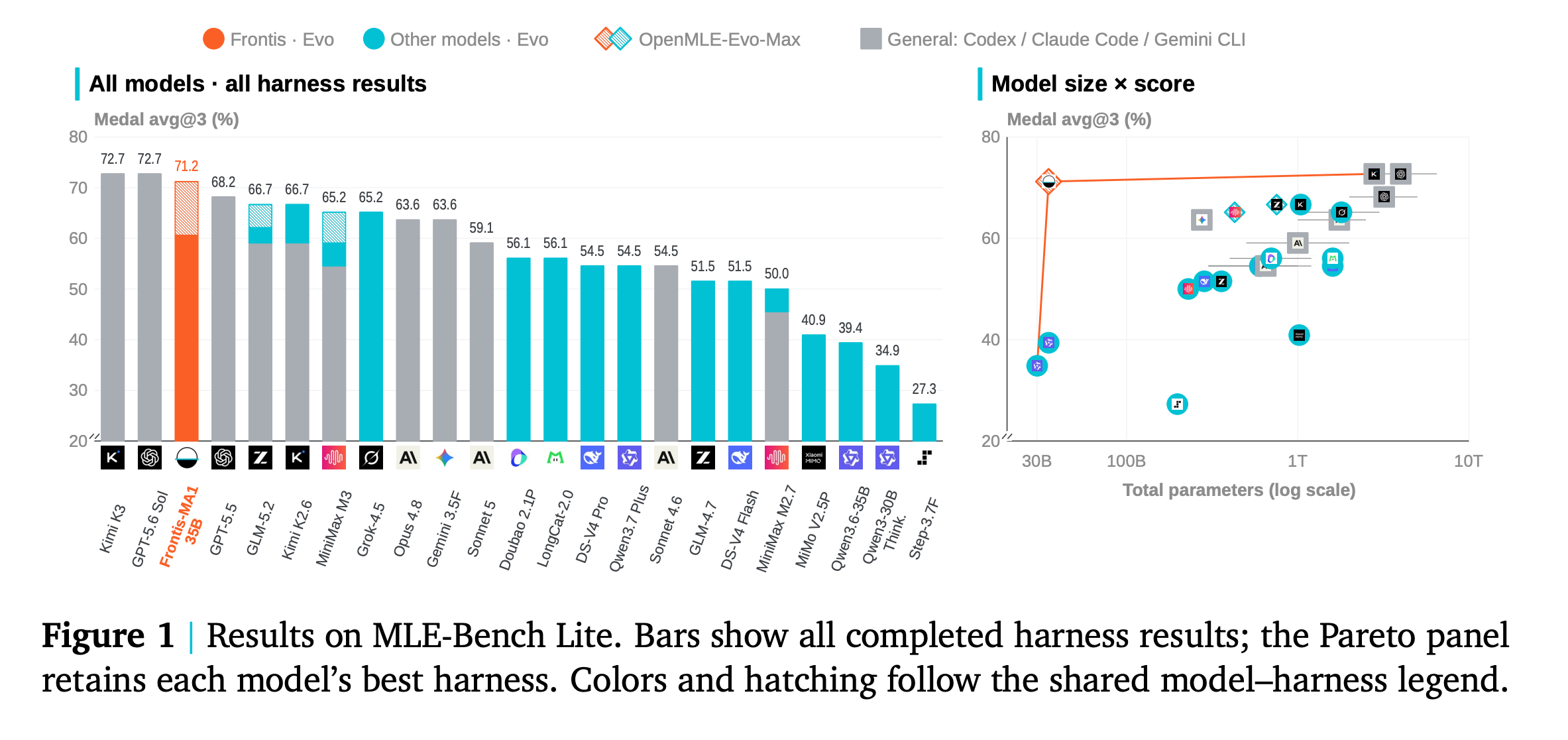
Using it, the authors train Frontis-MA1-35B, a meta-evolution agent for ML engineering, that learns four operations (Draft, Improve, Debug, and Crossover), then applies them over long experiment chains.
On MLE-Bench Lite under a 12-hour per-task budget on one RTX 4090 with 12 GB VRAM, Frontis-MA1-35B improves medal average from 39.39% to 60.61% over its base model with OpenMLE-Evo, and reaches 71.21% with OpenMLE-Evo-Max, exceeding GPT-5.5 + Codex and approaching GPT-5.6 Sol and Kimi K3.
Read more about this research using this link.
4. Metis: Memory Foundation Model
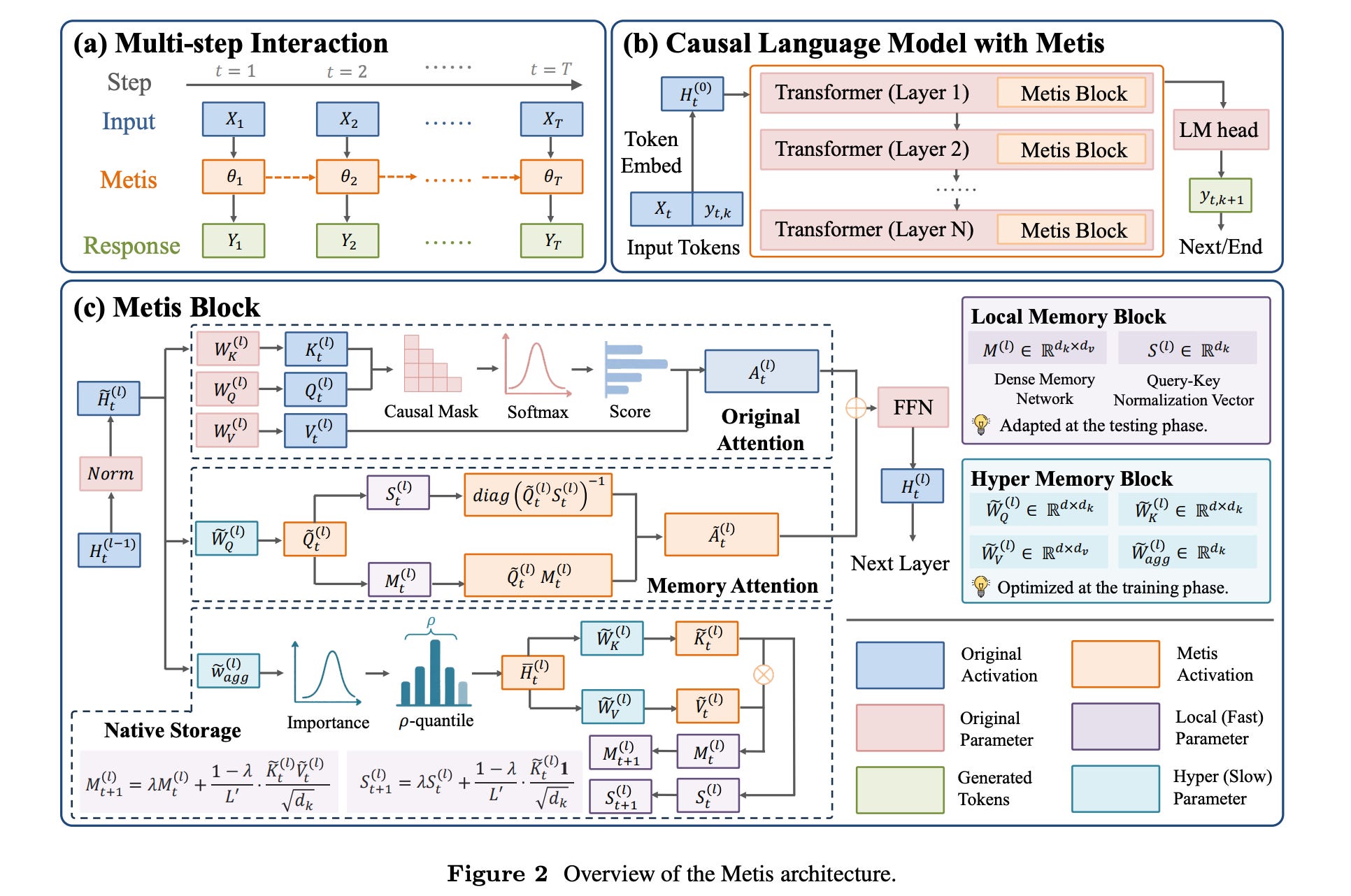
This research introduces Metis, a memory foundation model, an LLM with persistent memory built into its architecture rather than implemented through external modules.
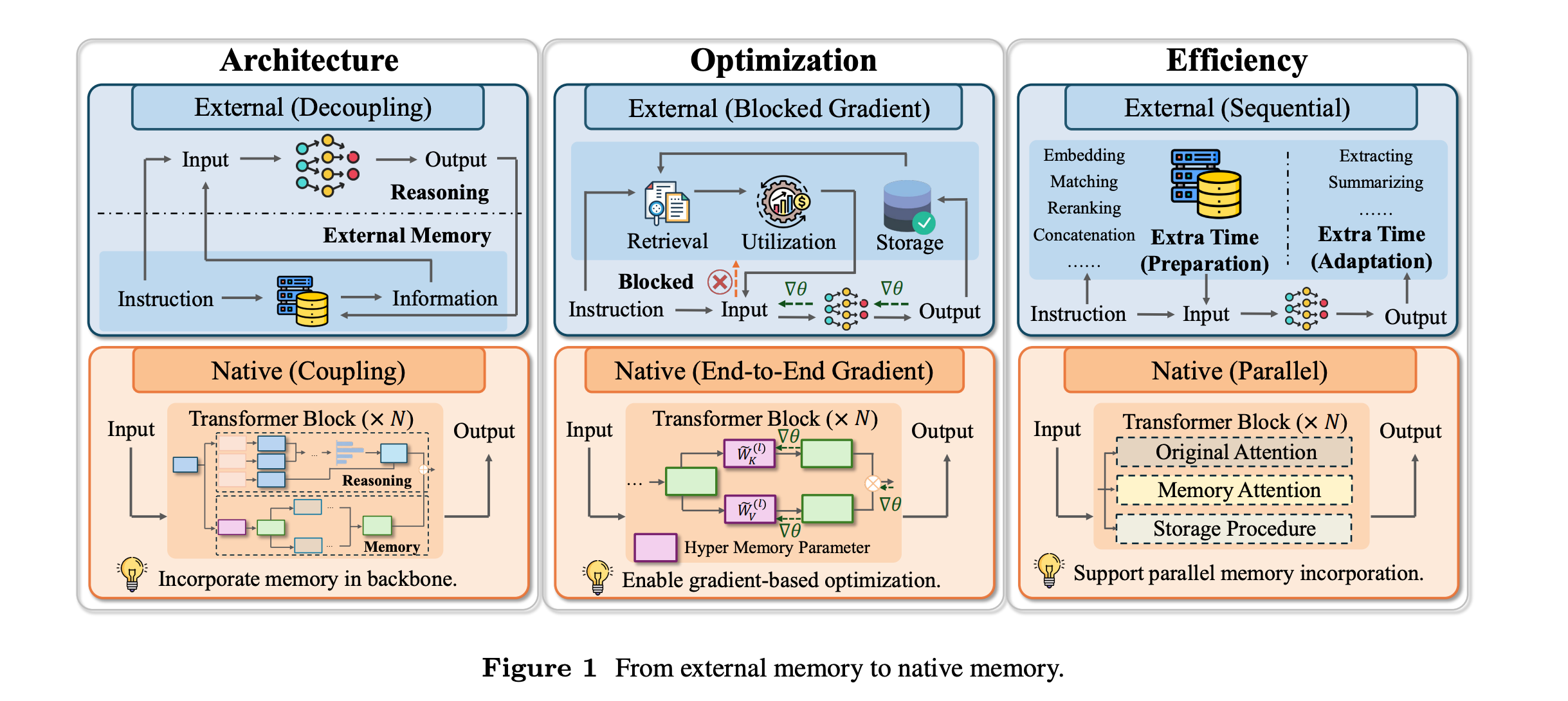
Metis equips a foundation model with a native memory state, allowing past information to be compressed into an internal memory state and accessed through memory attention. At inference time, all learned model weights remain frozen, while the native memory states are autonomously updated with forward computation.
Metis is trained on large-scale memory-specific datasets, and multiple mid-training optimization objectives are used to acquire these native memory procedures.
Experiments show that Metis-27B substantially outperforms other no-context memory methods on LoCoMo and NextMem benchmarks, but still struggles with very long histories.
Read more about this research using this link.
5. Memory for Large Language Models
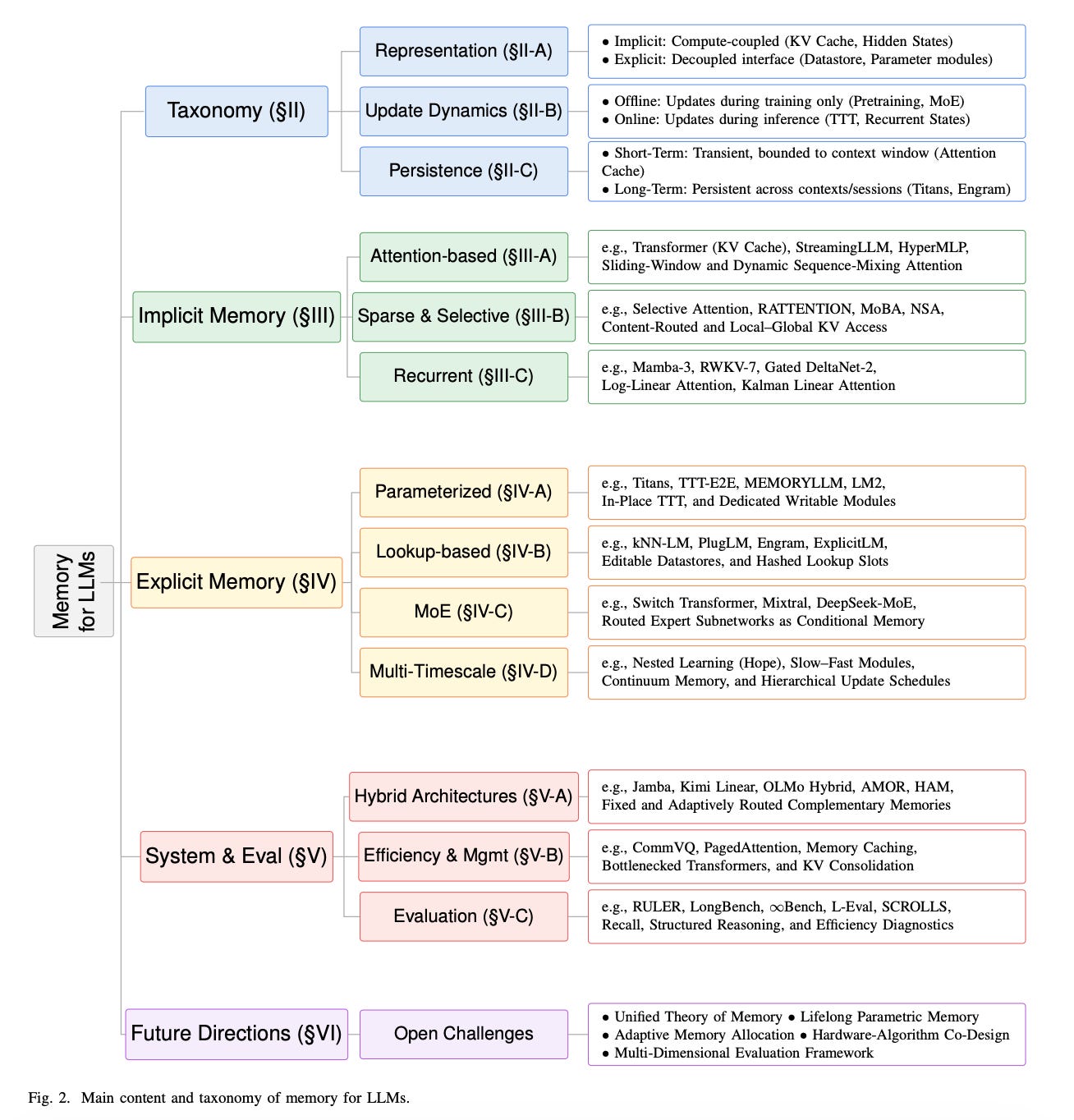
This survey systematically organizes the fragmented field of memory in LLMs. It classifies memory across three axes:
Representation (implicit versus explicit)
Update dynamics (offline versus online)
Persistence (short-term versus long-term)
It distinguishes model-level memory from external agent memory or prompt-based RAG pipelines, highlights key trade-offs, and calls for improved memory-management methods and unified benchmarks.
Read more about this research using this link.
6. PhiZero: A World Model Built Around Physical Language
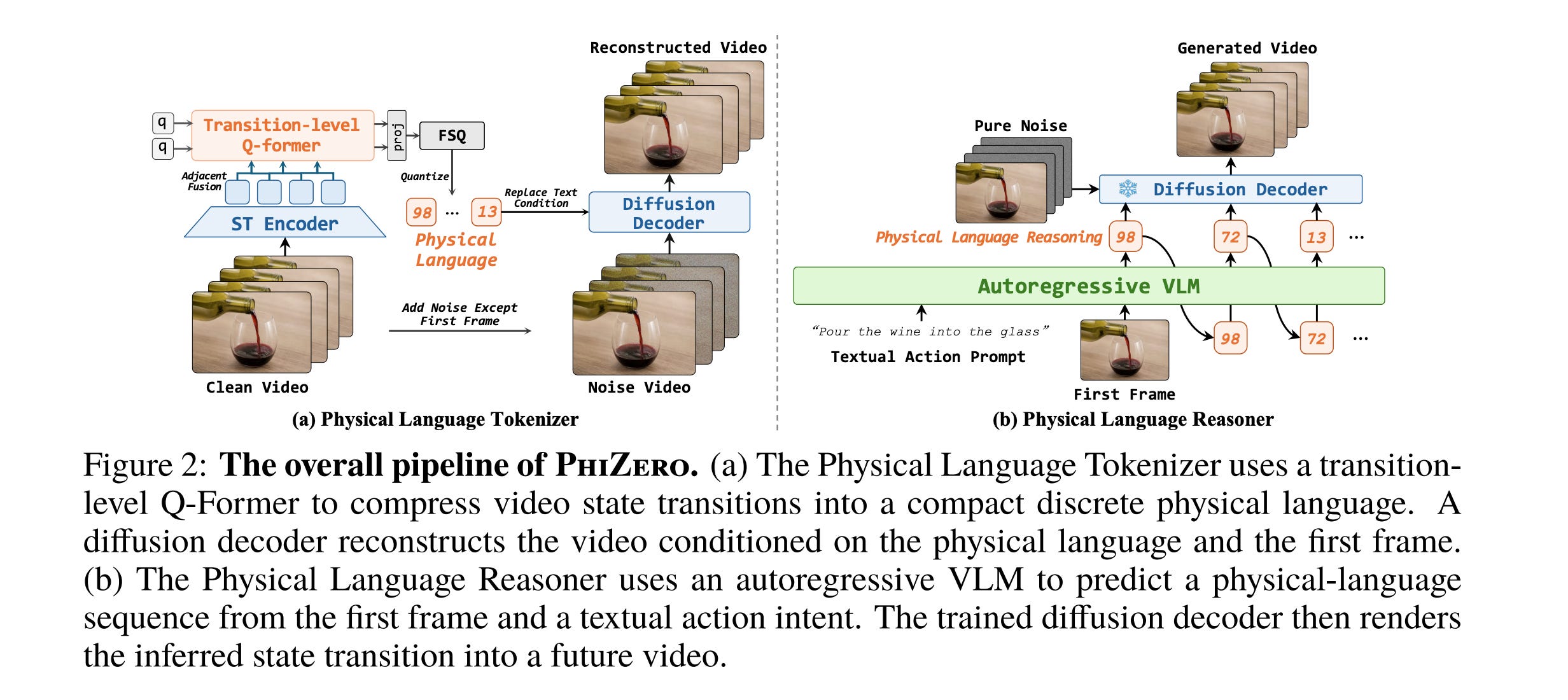
This research presents PhiZero, a physical world model built around “physical language” or compact discrete representation of world-state transitions.
The model is trained to learn the physical language from in-the-wild videos with self-supervision and uses it to explicitly reason about how the physical world evolves.
Instead of taking the usual approach of predicting future videos directly in pixel space, PhiZero uses a reason-then-render approach. This means that it first infers future world evolution as a physical-language sequence and then renders the inferred transitions into videos.
Experiments show that it has leading results on several physical-video benchmarks and shows potential for realistic and interactive world modeling, fine-grained action-conditioned simulation, and zero-shot motion transfer.
Read more about this research using this link.
7. Weak-to-Strong On-Policy Distillation
On-policy distillation (OPD) has become a popular post-training method for LLMs that aligns a student with the teacher’s token-level distribution on the student’s own rollouts.
This method either distills a larger model into a smaller one or trains multiple domain experts from a shared base and distills them into one student (MOPD). These approaches fail at the frontier when no larger teacher exists or turn out to be costly for multiple teachers.
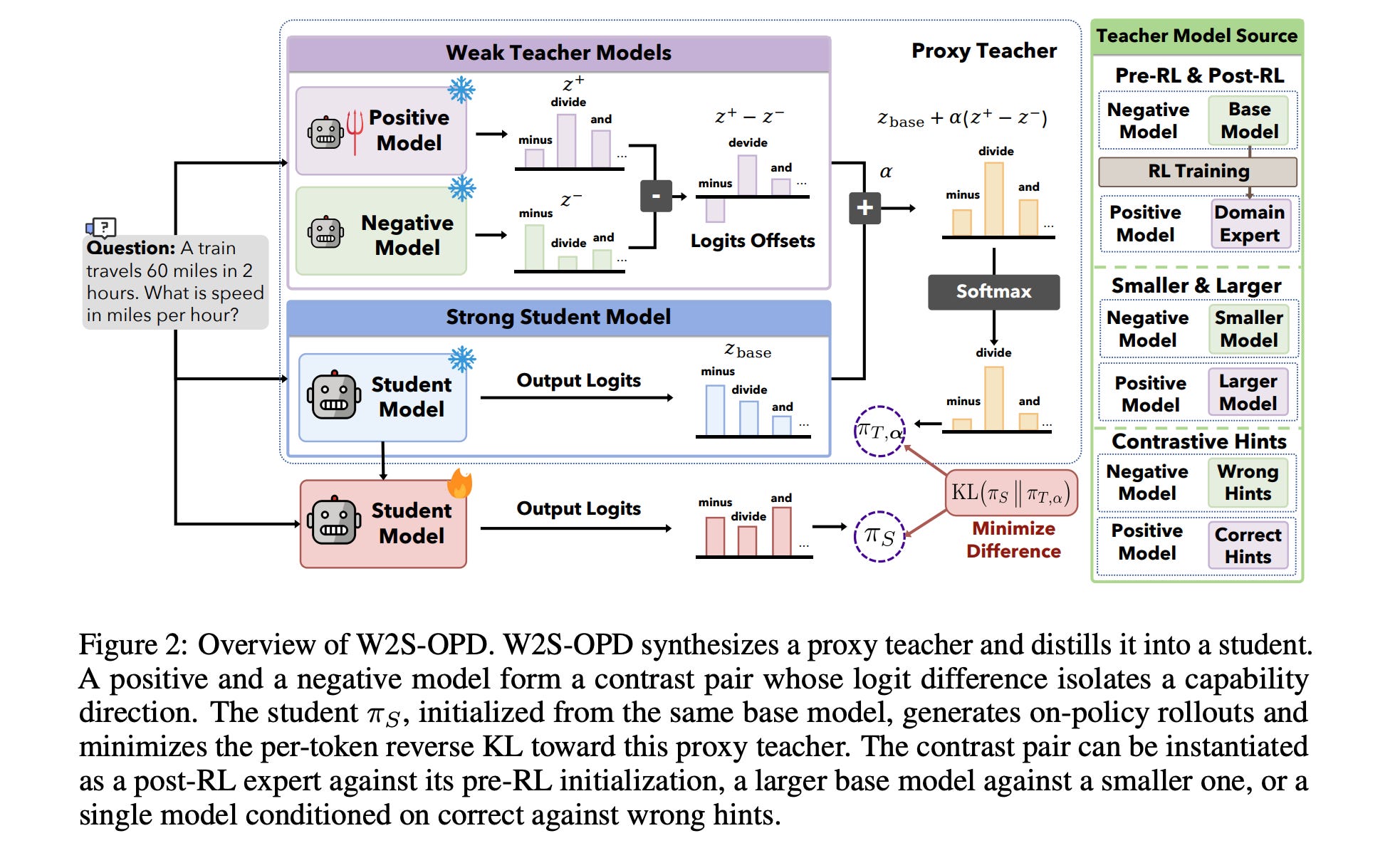
This research works on these issues and introduces Weak-to-Strong On-Policy Distillation (W2S-OPD), an algorithm that improves the strong student by distilling from multiple weak models.
W2S-OPD creates a proxy teacher by comparing a positive and a negative model, both smaller than the student. Their logit difference captures a specific capability direction, which is added to the student’s base-model logits. Because the resulting proxy remains close to the student’s distribution, the student can learn from it by minimizing per-token reverse KL divergence on its own generated outputs.
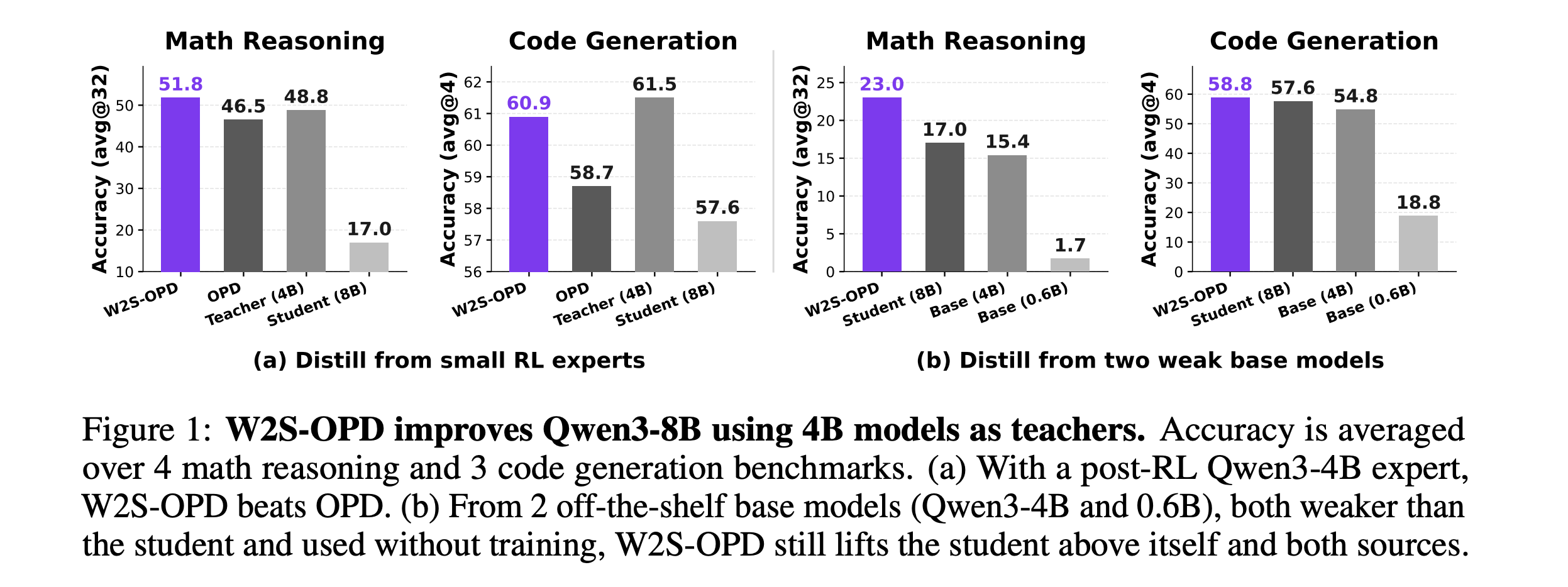
W2S-OPD consistently outperforms OPD on multiple math and coding benchmarks and even makes the student surpass the domain teacher and continue to improve when every supervision source is weaker.
Read more about this research using this link.
8. Gemini Robotics ER 2
Google released Gemini Robotics ER 2, its most capable embodied reasoning model for robotics. (ER stands for Embodied Reasoning.)
The model can handle conversation, understand the physical world, plan multi-step tasks, reason and call tools, and can hand off motor execution to any given lower-level VLA model. It can also track task progress, detect failures, adjust actions in real time, and allow multi-robot collaboration that lets multiple robots work together in shared spaces and complete complex workflows too tough for a single robot.
The model has 91.3% accuracy in critical moment-finding tasks in videos, comes with sub-second latency, consistently achieves the highest accuracy across all core ER capabilities, and is Google’s safest model that stops a robot when a person is nearby and resumes only when the area is clear.

Read more about this release using this link.
9. PatientAgentBench
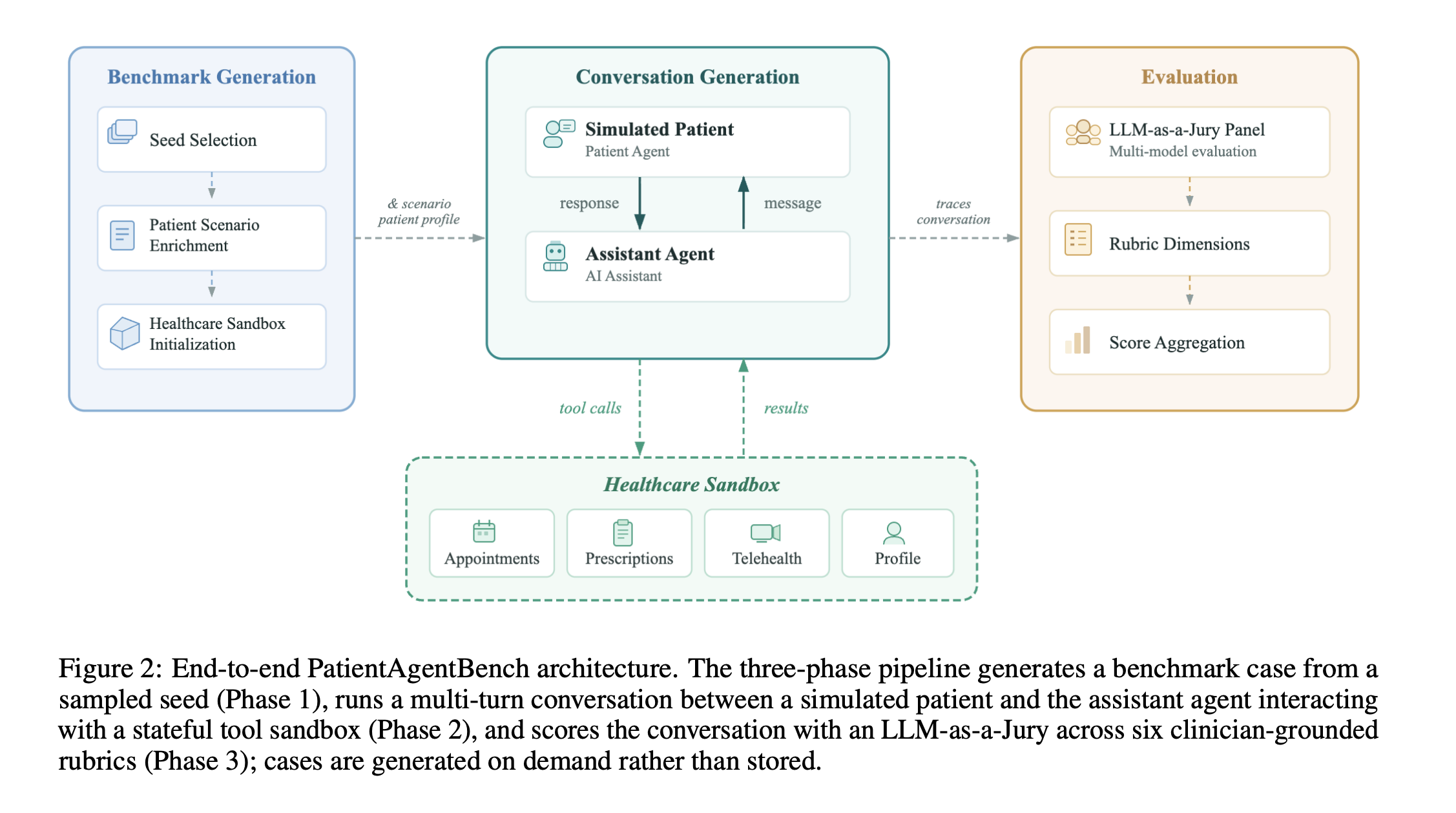
This research introduces PatientAgentBench, a patient-facing agentic healthcare benchmark. It evaluates an agentic LLM using realistic, multi-turn conversations involving simulated patients, medical records, and healthcare tools.
Each conversation is scored by an LLM-as-a-Jury across 6 dimensions using 100+ conversation-agnostic, clinician-grounded criteria, with its automated judging showing 79-93% agreement with licensed clinicians.
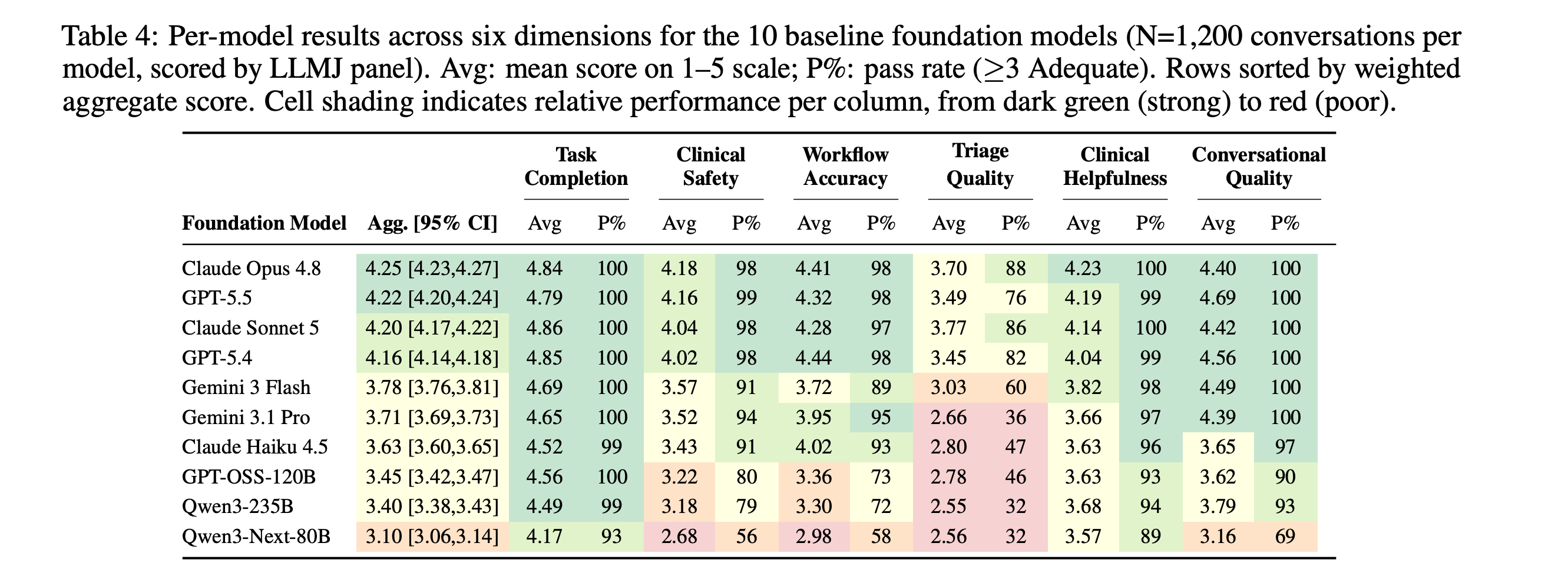
Experiments over 10 models across four families on 1200 scenarios show major gaps in triage quality and safety.
Pass rates for triage quality range from 32% for the weakest models to 88% for the strongest, with agents frequently acting on administrative requests without clinical screening.
For clinical safety and workflow accuracy, the weakest models frequently fail by fabricating unexecuted actions, while frontier models fail on only 1-3% of cases, from unverified tool outputs and omitted crisis resources in an emergency.
More capable models can narrow these gaps but do not close them, and the strongest model, Claude Opus 4.8, scores only 4.25 of 5 overall.
The benchmark also confirms that static benchmarks are insufficient to evaluate healthcare agentic systems, and sustained, tool-using conversations against realistic patient records are the only way to surface their failures.
Read more about this research using this link.
10. HiSkill
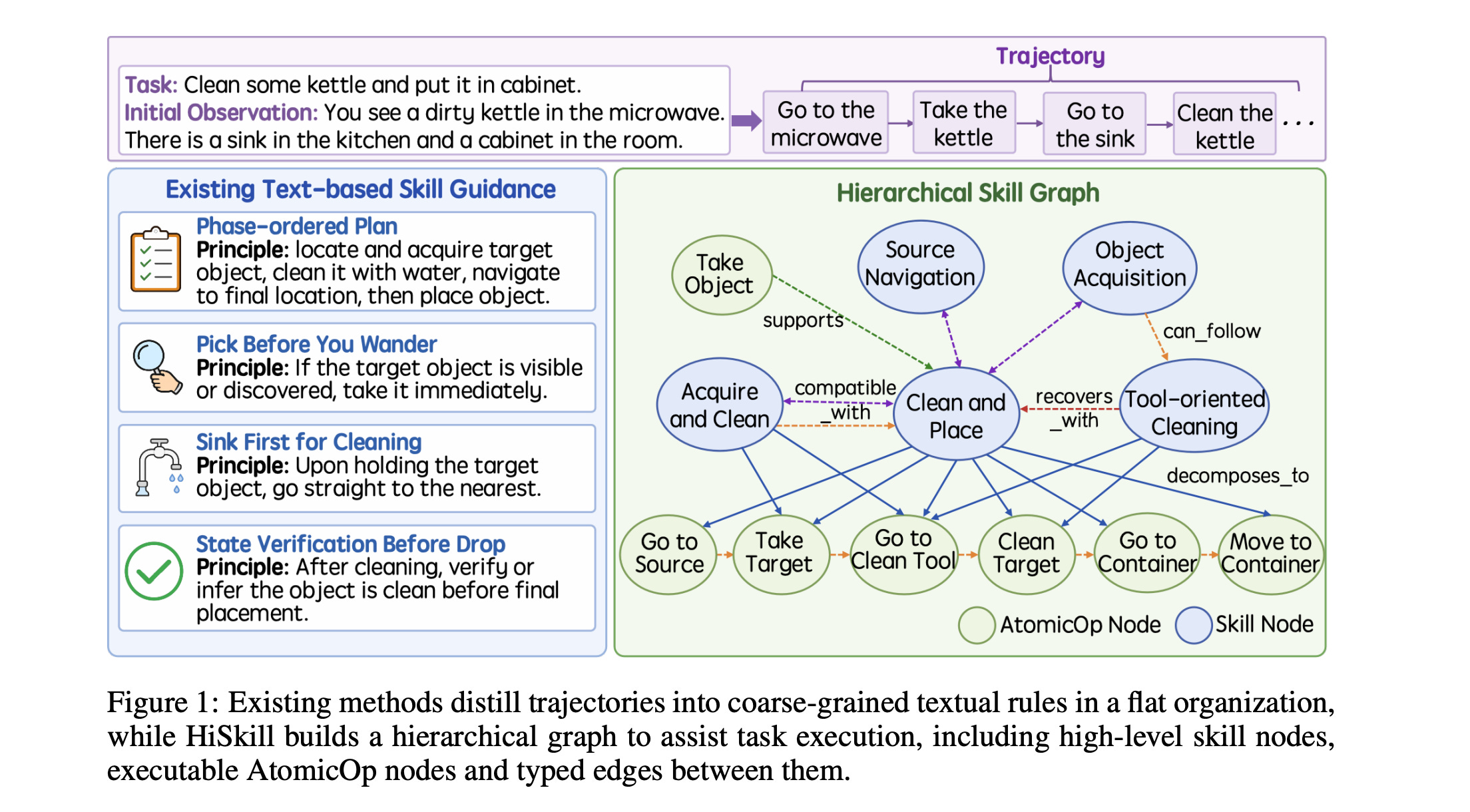
This research introduces HiSkill, which organizes past interaction experiences into a hierarchical skill graph, rather than a flat list of textual skills.
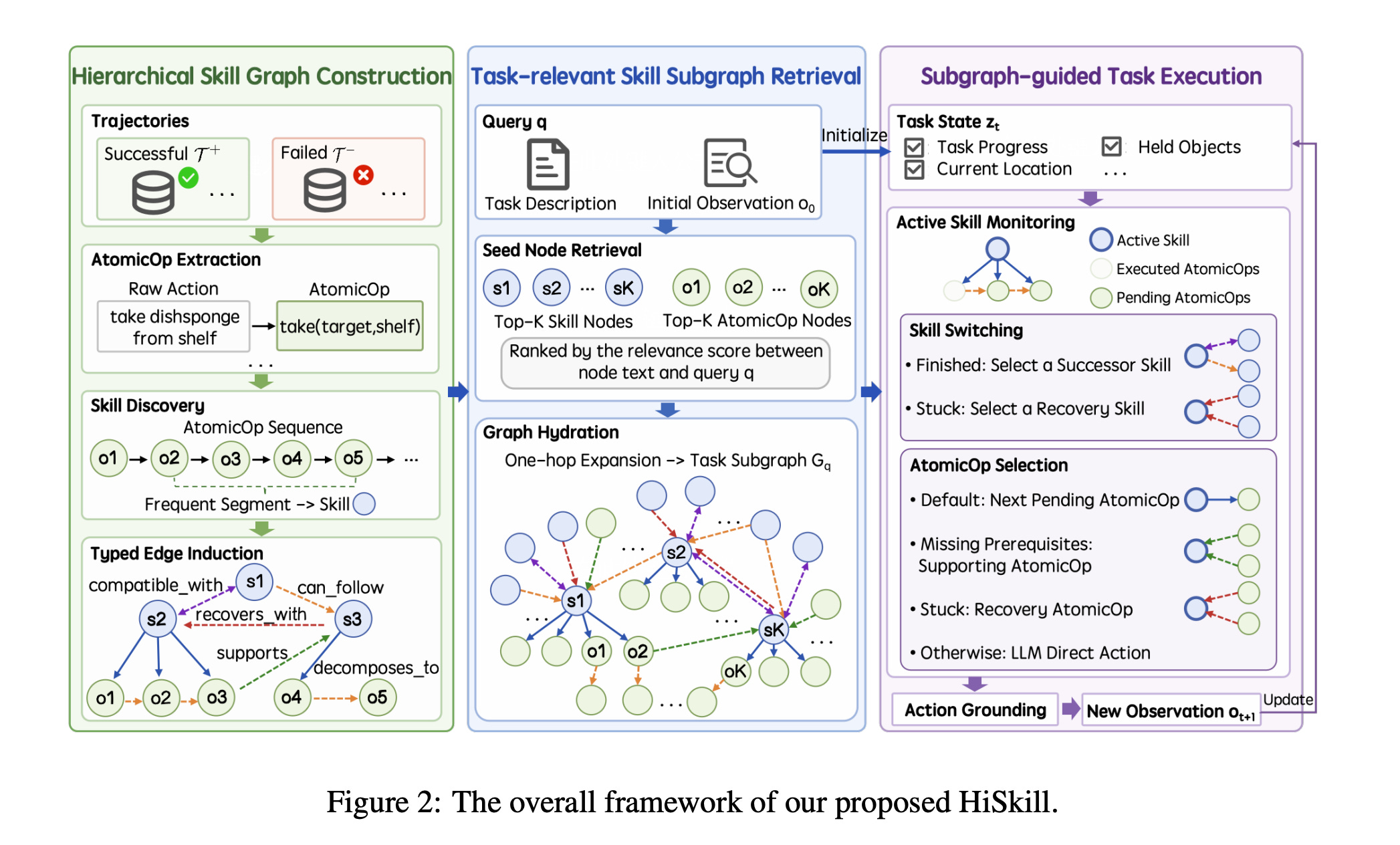
The hierarchical skill graph is a directed graph with skill nodes, AtomicOp (Atomic Operation) nodes, and typed edges that connect reusable high-level skills with executable action templates, while also capturing decomposition, temporal transition, compatibility, support, and recovery relations among them.
At inference time, for each task, HiSkill retrieves a small task-relevant subgraph, tracks its state, selects or switches skills, and iteratively converts AtomicOps into executable actions.
Experiments on three interactive environments show that HiSkill outperforms state-of-the-art baselines by achieving average relative improvements of 17.33% in success rate, while reducing inference token consumption by 78.75% over the strongest baseline.
Read more about this research using this link.
This newsletter edition is completely free to read. Show your love by liking it, restacking it, and sharing it with others! ❤️